
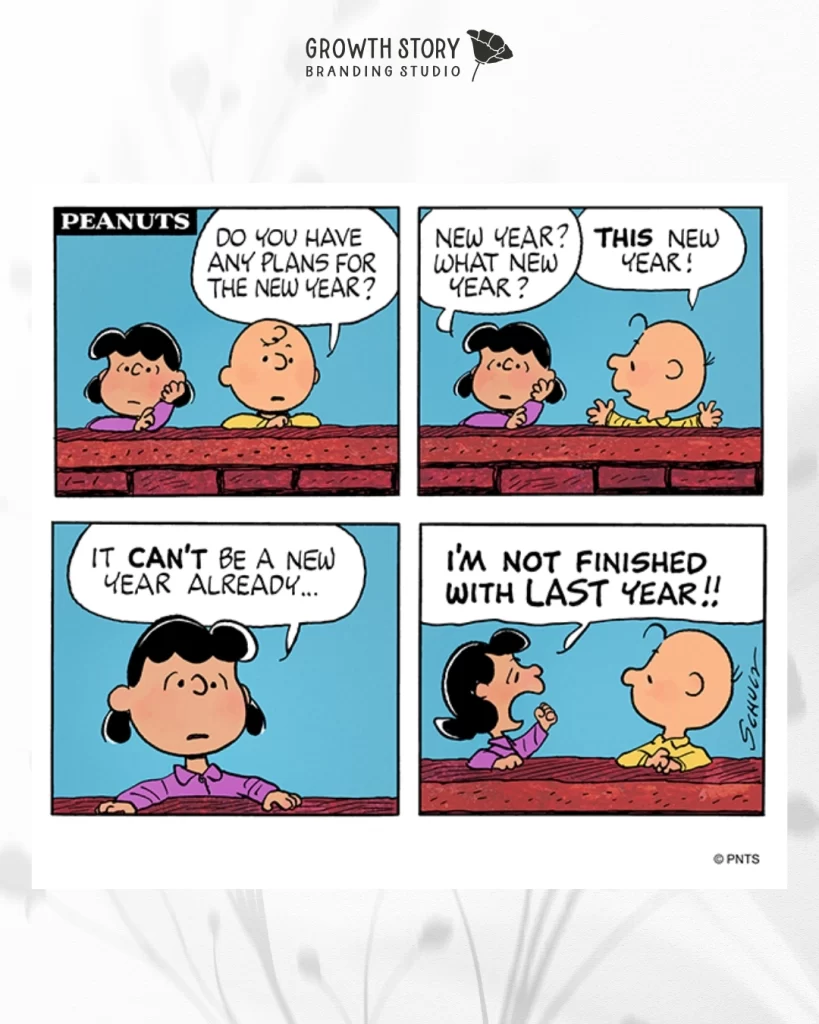
There’s something so refreshing about a new year. Even if it’s arbitrary, flipping the calendar to a new year always makes me feel like the world is my oyster. If you’re like me, you want to start the year organized and end the year organized. And if you’re like me, your social media content can be anything but organized.
For those running boutique firms and solopreneurs, getting ahead of social media can feel like a daunting task. Do any of these social media panic thoughts sound familiar?
- I haven’t posted in 2 weeks and I have no idea what to post but I know that I need to!
- Omg who knew it was this national holiday that is very relevant to my brand…I need to share a post about it NOW.
- I want to increase engagement with my brand’s social media channels, but I am not super comfortable showing my face in content.
- I’m fine showing my face in content, but I’m not getting much engagement and I don’t really know why.
Just writing those out raised my blood pressure—because I’ve been there, and honestly, I’m still there sometimes.
So how do we conquer posting paralysis? By getting our social sh*t together. Here’s how:
- We’ll start by talking about what you actually should be sharing on your brand’s social media accounts.
- I’m going to give you a pep talk about how often you truly need to be posting and a secret for getting your face on there cringe-free.
- Then you get a social media template for Google Sheets (transfer it to Excel if you like!) that will get you started on the right path for 2026.
Along the way, if you get totally lost or overwhelmed, send me a message on Instagram and we can chat through solutions.
Take a deep breath and let’s dive in!

How is social media relevant to branding?
When my close friends catch me in a rant over the importance of branding, I always end up word vomiting about how branding makes founders lives easier from the beginning.
First, let’s get into what brand strategy is.
Once you have a branding strategy, certain tasks become so much less time consuming, take up less of your brain power, and leave you with more time to focus on business-building tasks. When businesses and founders that have been winging brand strategy from the start finally choose to invest in professional branding, they don’t know how they functioned without it.
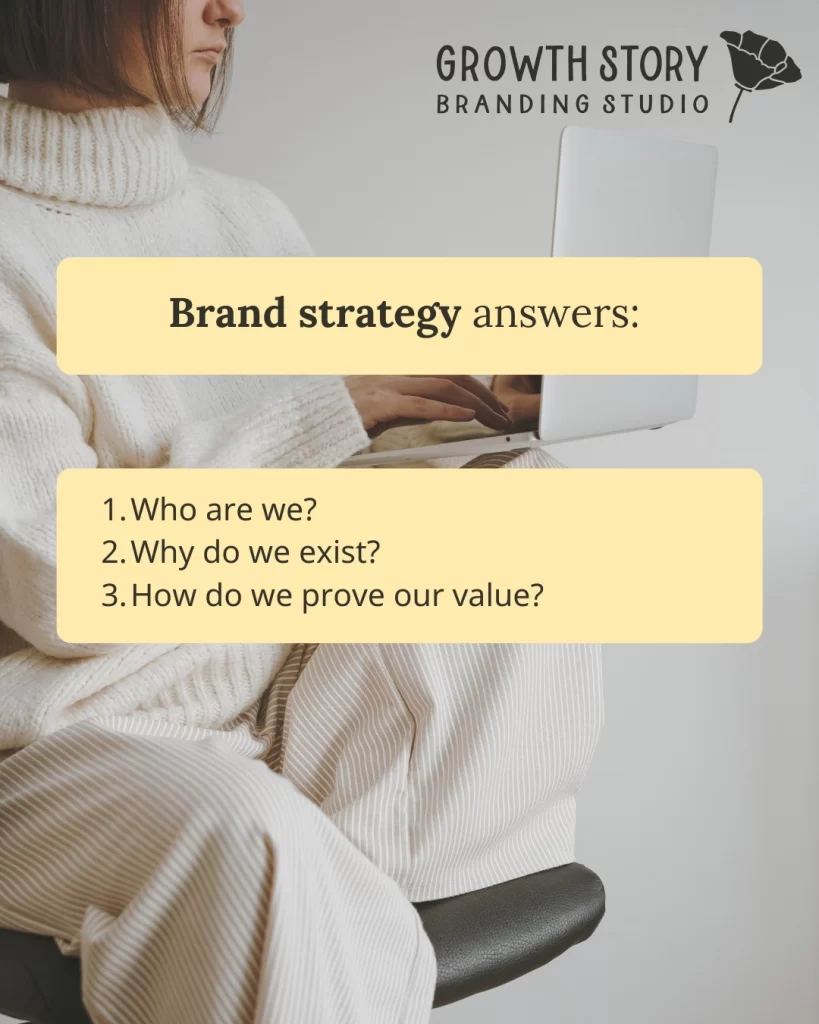
This is because branding strategy is a foundational part of a comprehensive business strategy. Brand strategy answers questions like:
- Who are we?
- Why do we exist?
- How do we prove our value?
More specifically, brand strategy and the guidelines that they produce detail who your target audiences are, what words you need to use to connect with them, and how your connection with your audience contributes to the mission and vision of your business.
Here’s a simpler way to think about it: A good brand strategy gives you a go-to document you can copy and paste from whenever you need a quick blurb about your business or yourself as a founder.
Media release “about the business” boiler plate? Done for you.
Mission and vision statements for a pitch deck? Done for you.
How to answer “what makes us different”? Done for you.
Basically, it’s the best. I digress…
The social media and branding connection
Social media and branding go hand-in-hand. Brand strategy provides the brand clarity that creates the blueprint for social media content.
As you’ll see later in the 2026 social media content calendar template, there are a few brand-specific things you need to keep track of for each social post.
- Audience
- Topic
- Format
Brand strategy answers who your audiences are and what messaging, content types, and platforms they resonate with. Messaging guidelines derived from brand strategy development give you content topic pillars.
When you have that information done for you, all you’re left with is writing captions and creating graphics or videos, both of which can be supported by AI or apps like Canva and Capcut.
(Note: I said supported by AI. When you use AI without edits, it’s obvious and usually cringey–use it as a springboard, not the final output.)
In fact, a solid brand strategy will help your AI-generated content be so much more on-brand.
If you’re interested, we can get clear on your audience, messaging strategy, and brand voice with a Brand Clarity Session.
What should you be sharing on social media in 2026 for service-based businesses?
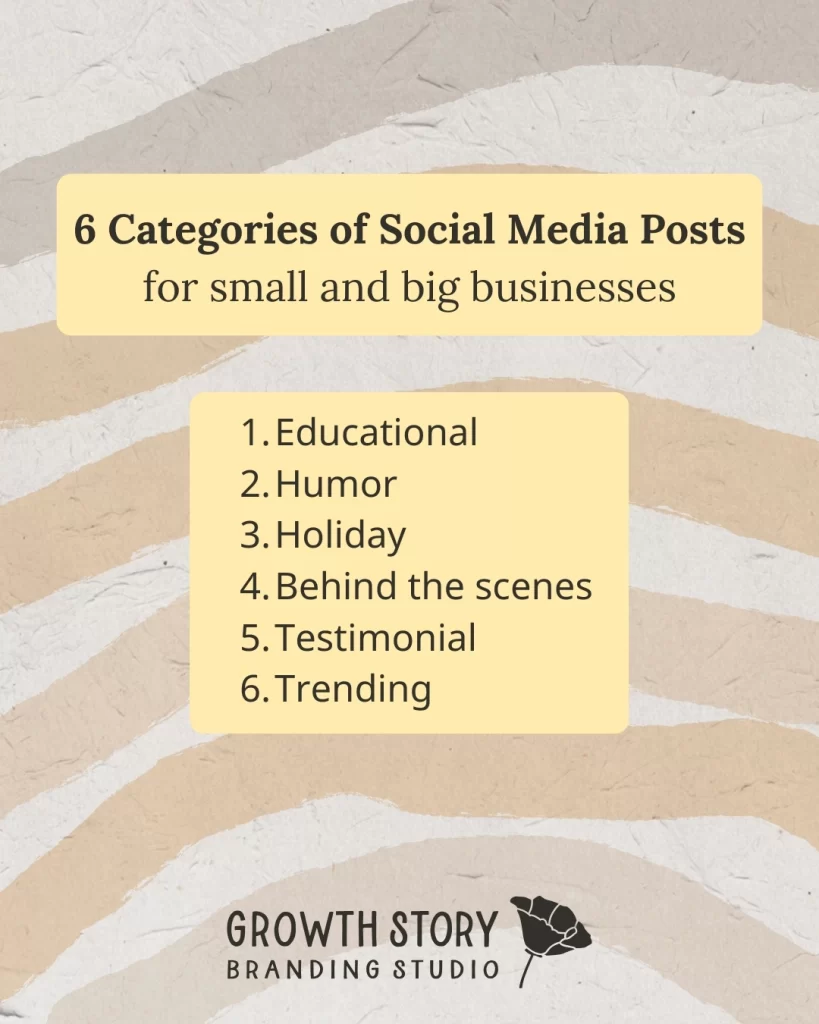
There are about 6 overarching categories of content that all brands can utilize when outlining their social media plans.
- Educational
- Humor
- Holiday
- Behind the scenes
- Testimonial
- Trending
These categories (found in drop-downs in the ‘Category’ column on the ‘Content’ tab of the social planner) allow you to space out content so it stays relevant to your audience.
Here’s a description for the main content categories:
- Educational: What can you teach your audience that proves you are an expert in your field?
- Humor: What can you poke fun at or leverage that your audience would connect with through humor?
- Holiday: What holidays are relevant to the mission and vision of your brand?
- Behind the scenes: What can you show from the behind-the-scenes moment of your business that will humanize the brand?
- Testimonial: What can you share as social proof that you can walk the walk as well as you talk the talk?
- Trending: What memes, challenges, or trending audio can you use to stay relevant without seeming inauthentic?
The key is to share content from each category (or pick a few…maybe your brand voice is more serious than ‘humor’ or ‘trending’ allow for) that is relevant to your brand.
Understanding content pillars in social media strategy
You might have heard marketing professionals talk about content pillars like it’s a household term, but from my time in marketing agencies, I know that us regular folk hear ‘content pillars’ and do the little doggy head tilt.
I had to pick it up as I was hazed in the marketing agency, but let’s skip that step for you and make it easier to understand. Content pillars are the main topics your brand focuses on in its comprehensive marketing strategy.
Here’s an example based on Growth Story. We provide branding services for business owners and firms in financial services, legal services, consulting, coaching, and community-based businesses. Our content pillars include the following:
- Brand strategy
- Visual branding
- Brand messaging
- Digital marketing
- Website design
- Social media for service businesses
Each of these pillars either aligns directly with one of our services or is relevant to our target audience (sole proprietors or founders of small firms). The content we create beneath each pillar adds value to our audiences and reinforces our expertise. We know what we’re talking about and rather than gatekeeping it for our audience (who we hope to work with eventually), we share it so they see the value they would get from partnering with us.
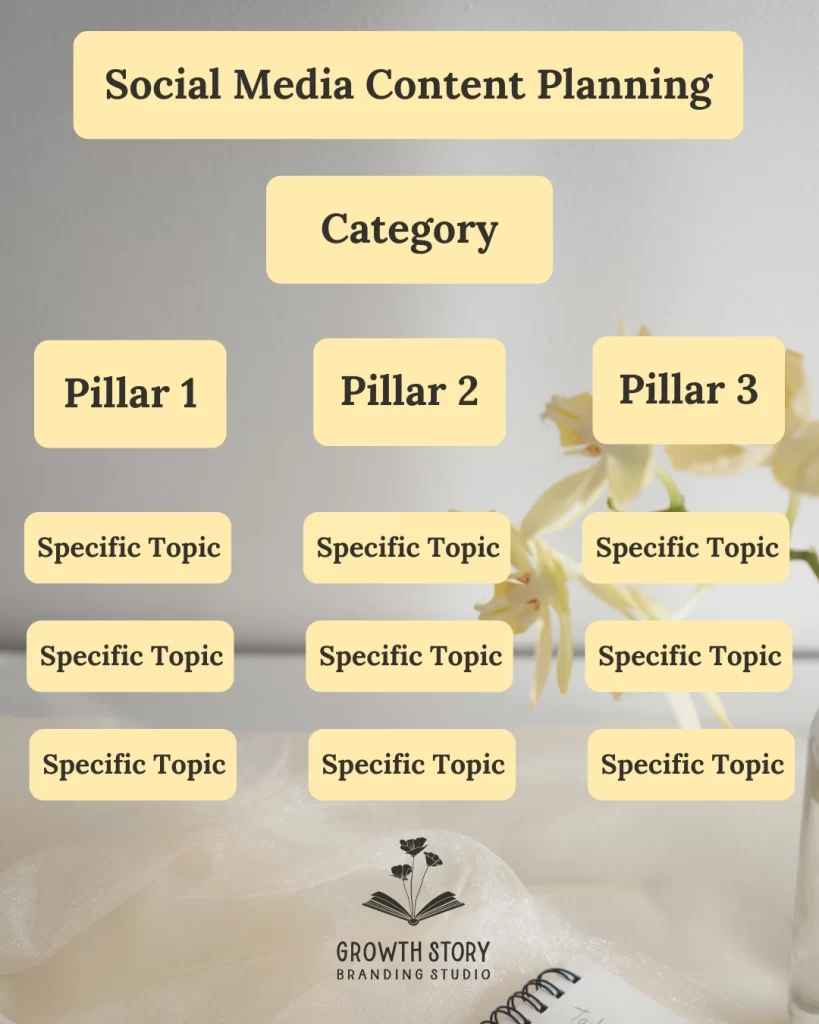
How can you apply this to your business? Create a list of topics directly related to your brand’s services or products. You can be vague or very specific. Do a mind dump then dump that dump into ChatGPT and have it create high-level content categories based on the list.
If it aligns with your brand values, then boom, you have your content topics and can edit that drop-down in the content planner. If it doesn’t, reach out to me and let’s try something different.
It’s time for the pep talk: if posting to social media sounds totally overwhelming, start here.
There are a few reasons you might be overwhelmed with the idea of posting to your business social media accounts:
- You don’t know who your audience niche is (or should be)
- You don’t know what to say
- You are terrified of the idea of showing your face on there
- You can’t keep up with the trends and required posting frequency
- You have a lot of ideas but are too frazzled to get them out of your brain and into the world
Now, for the solutions.
Roadblock #1: Understanding your audience
Your audience is your favorite client or the exact person your product was created for. Your audience has desires and pain points that your products or services solve. They share attributes with each other and have a specific buying behavior and lifestyle. Your ideal audience might be different than the audience you currently have following your Instagram–but don’t worry, that can change.
If you read all that and thought “I have no f*cking idea who my audience is,” go ahead and set up some time to chat with me. Digging into your audience is one of my favorite ways to play brand strategy detective.
Roadblock #2: You don’t know what to say
I mean, who really does know what to say. Sometimes I start a sentence and end up somewhere totally different by the end of it, just as confused as anyone. See this entire blog post as an example.
But there are ways to make it easier to know what to say. Comprehensive messaging guidelines provide the best solution to this roadblock. Messaging guidelines outline your brand’s voice, tone, key messages, core values, taglines, personality, and even language dos and don’ts.
When combined with your target audience details and messaging pillars, brand voice guidelines make the beginning stages of creating social media content simple because you know who you’re speaking to and what they need to hear from your brand.
Filling out the columns on the planning document in detail will help you overcome this roadblock.
Roadblock #3: “I don’t like posting my face on social media”
I get it, trust me. But here’s a little secret I always share with my clients—and now, I’m sharing it with you
Post the damn thing. Post it and throw your phone across the room, if you must.
Then, when someone says to you “wow, I can’t believe you posted that video of yourself talking about the thing you know so much about that you started a business based on it”–which, by the way, will never happen–you get to say this to them:
“Ugh, I know, so cringe right? But my social media manager made me do it, so I had to.”
Blame that social media manager for everything that makes you feel imposter syndrome!
And know that the reality is you’ll receive comments from your friends and clients like “aw, I love seeing this side of you” or “so good to see your face” or “yesssss, more YOU content, please!”
Send me a message on Instagram if you aren’t getting this feedback and I’ll volunteer to be your cheerleader.
The truth is, sharing yourself on social media for the good of your business is important, because people want to give their money to people, not anonymous logos.
Note: I’m not hating on logos–that’s a huge part of my business, but showing your face is just going to increase your audience’s trust in the professional brand you’ve paid me to create for you.
What’s that…we aren’t working together yet? Forget I said that…or send me an inquiry and let’s get started.
Roadblock #4: You can’t keep up with the trends and required posting frequency
I’m so sorry that anyone ever made you think you have to be posting a certain amount of times each week. I like to keep things real, okay? Here’s the honest truth for service providers operating solo or with a small team:
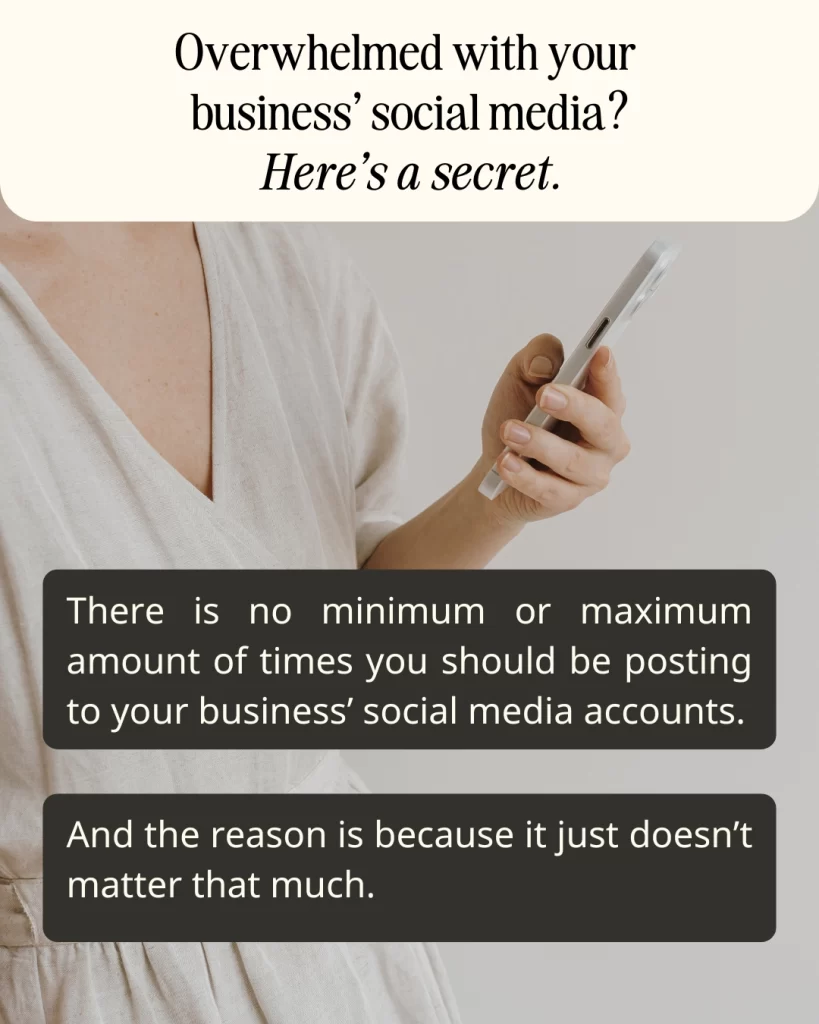
There is no minimum or maximum amount of times you should be posting to your business’ social media accounts.
And the reason is because it just doesn’t matter that much.
Unless social media is your main source of new clients, there’s no need to stress about hitting five posts and 45 Stories on Instagram every week.
You should be posting semi-consistently to show your business is active if a prospect is screening your socials, but there’s no need to go crazy. After all, you’re not a content creator. Your clients are hiring you to do the thing you excel at.
Here are some examples of small firm social media posting schedules:
- 2-3 posts per week, 1 Instagram Story a day
- 2-3 Instagram stories per day, new posts only when they create value or are highly relevant to the brand
- 1 post a week
- 1 Reel a month, other static posts when time allows
There’s a range of normal for boutique firms on social media. And that’s totally okay.
But posting every once in a while (at least once a month) tells users who aren’t following you yet but have stumbled upon your account that you are relevant and active, encouraging them to follow you.
If you can’t get a post up, then try to get a Story up. If you can’t do any of it for a few weeks because you’re really busy with other aspects of running your business, (or maybe you’re burnt out from the dumpster fire happening in the US at any given time), then that’s fine. It’ll be there when you’re ready.
In marketing, we call followers a “vanity metric,” because unless each of your followers are becoming a client and spending money on your services, they don’t really contribute to your margins.
Remember this the next time you’re beating yourself up for not posting “enough.”
Roadblock #5: So many ideas, so little plan to get them posted
I’m about to hand you your solution, my friend. It comes in the form of a Google Sheet template social media planner that includes a calendar and content strategy.
I’ve used this template for years—it works for both full marketing teams and solopreneurs alike. Ready?
The 2026 Social Media Content Planner Template for Google Sheets
If you’ve reached this point, you either skipped ahead or learned something new about what you need to create content that resonates with your audience in 2026. If you still have questions, please reach out.I’d love to nerd out with you about your content pillars and audiences.
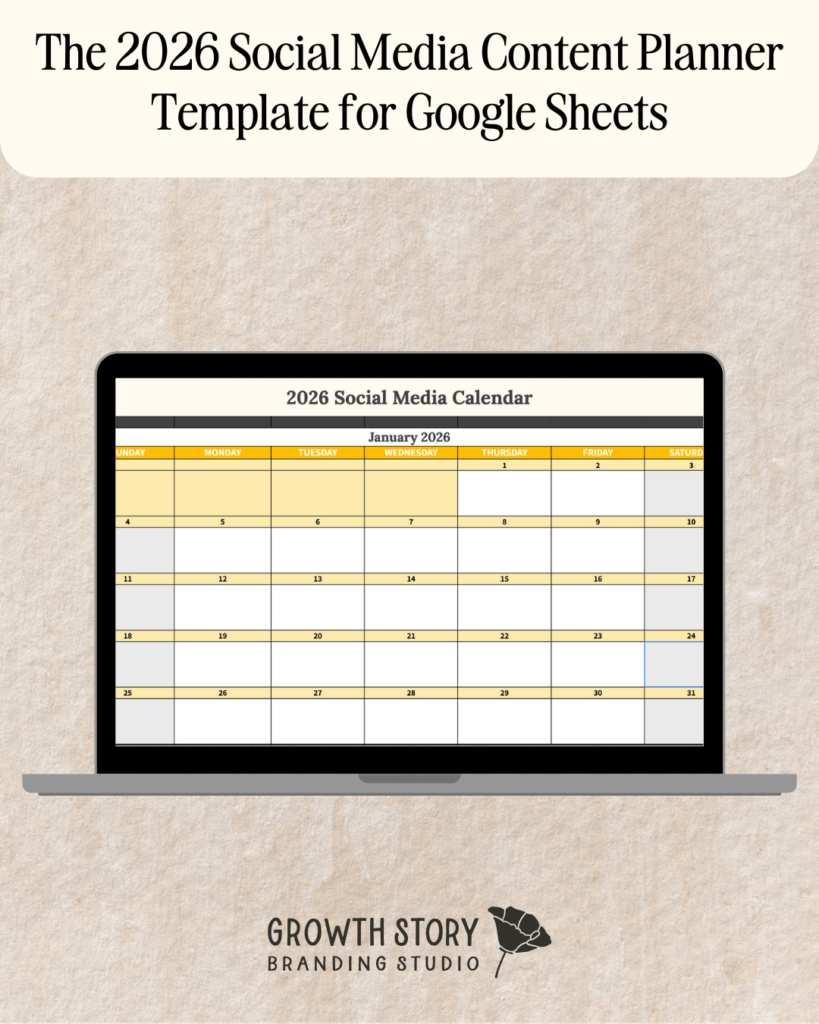
The 2026 social media content planner template includes 2 tabs. The first is a monthly social media calendar overview. Not everyone will use this tab, but I am a visual person and it helps me to see the posts outlined on a monthly basis. It’s also easy to copy/paste to move posts around on the calendar if you need to.
The second tab is the detailed content planner. This is where you can dump ideas, schedule posts, update a status, leave links to Canva designs, write out captions, and more.
If your brain works like mine, it might be helpful to fill out the monthly overview then have it open with the planner in a different window side-by-side to start writing out content details. This works best on a large desktop.
It’s yours to use how it will work best for you. Delete comments, update the fonts and colors to match your branding, edit the drop down options.
Choose file > make a copy to save it to your own Google Drive (note: you must be logged into Google to make a copy). You can also export it as an Excel template if you’d like to.
If you have questions or feedback about the template, reach out to me.
This template is the intellectual property of Growth Story. © Growth Story LLC. All rights reserved. It is provided for personal or professional use only and may not be reproduced, redistributed, or sold as a template or product created by any entity other than Growth Story LLC without prior written permission.
Sending you off with one last motivational message
As a service-based business owner with a small support team myself, I’m with you. Social media still overwhelms me sometimes, and I still feel that invisible pressure to post—even when I have nothing valuable to say.
I have to walk myself back from these thought patterns because even if I’m not posting often on my business page, I’m still online and interacting with my community.
At the end of the day, social media was created to connect us with each other. Think about how you can use it to feel connected to your audience or your community. How can you use it to encourage a connection between your audience and your brand?
I know you can do it.
Follow me on Instagram or add me on LinkedIn if you want to continue this conversation. 💛
Frequently asked questions about social media for boutique firms
There’s no one-size-fits-all answer! For most small firms, posting 2-3 times a week and showing up in Stories when you can is enough to stay consistent. The key is quality over quantity. Don’t stress about hitting a magic number—focus on providing value and staying relevant to your audience. And remember, social media is a tool, not your full-time job.
Content that resonates with your audience and aligns with your brand! Mix it up with educational tips, behind-the-scenes moments, testimonials, and even a little humor or trending content (if it fits your voice). Start with 3-4 content categories that feel authentic to your brand and stick to them.
Planning is your best friend. Use a content calendar to map out posts in advance, and rely on tools like Canva or Capcut to streamline design. Start with a template (like the 2026 planner!) and focus on one post at a time. You don’t have to be perfect—just consistent. And if you feel stuck, I’m only an email or Instagram DM away. 😊