
For better or for worse, there’s no doubt that AI is changing the way we work. We conducted a survey asking professionals about the impact of AI in creative industries to gather data on how AI is currently affecting their day-to-day. This post contains those survey results, as well as relevant stories from those working in creative fields.
Why We Surveyed Creative Professionals About AI
Growth Story surveyed creative professionals, including (but not limited to), website designers, copywriters, SEO specialists, marketing strategists, graphic designers, and more.
We wanted to hear from creatives specifically, because we have seen firsthand how creative services are increasingly being outsourced to AI. We knew we couldn’t be the only creative agency experiencing AI come up in conversation almost daily, and wanted to identify patterns that may be existing across different creative roles.
Survey Demographics
We compiled responses from 24 creative professionals across various fields for this survey. Here are the demographics.
Gender Identity and Age
Gender Identity:
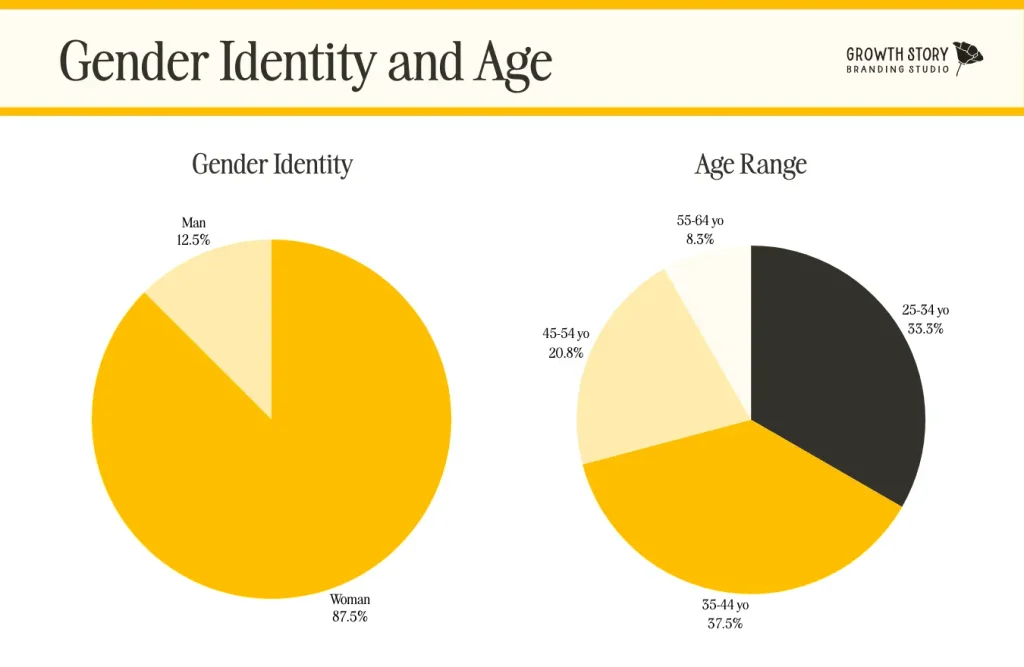
This survey was primarily taken by those who identify as a woman, with 21 female vs. 3 male respondents. Typically, men dominate the AI conversation, so we were intrigued to get so much feedback from women specifically.
Age Range:
Roughly 70% of responses came from those under 44, split almost half-and-half between 25-34 and 35-44.
Industry and Role
Industry:
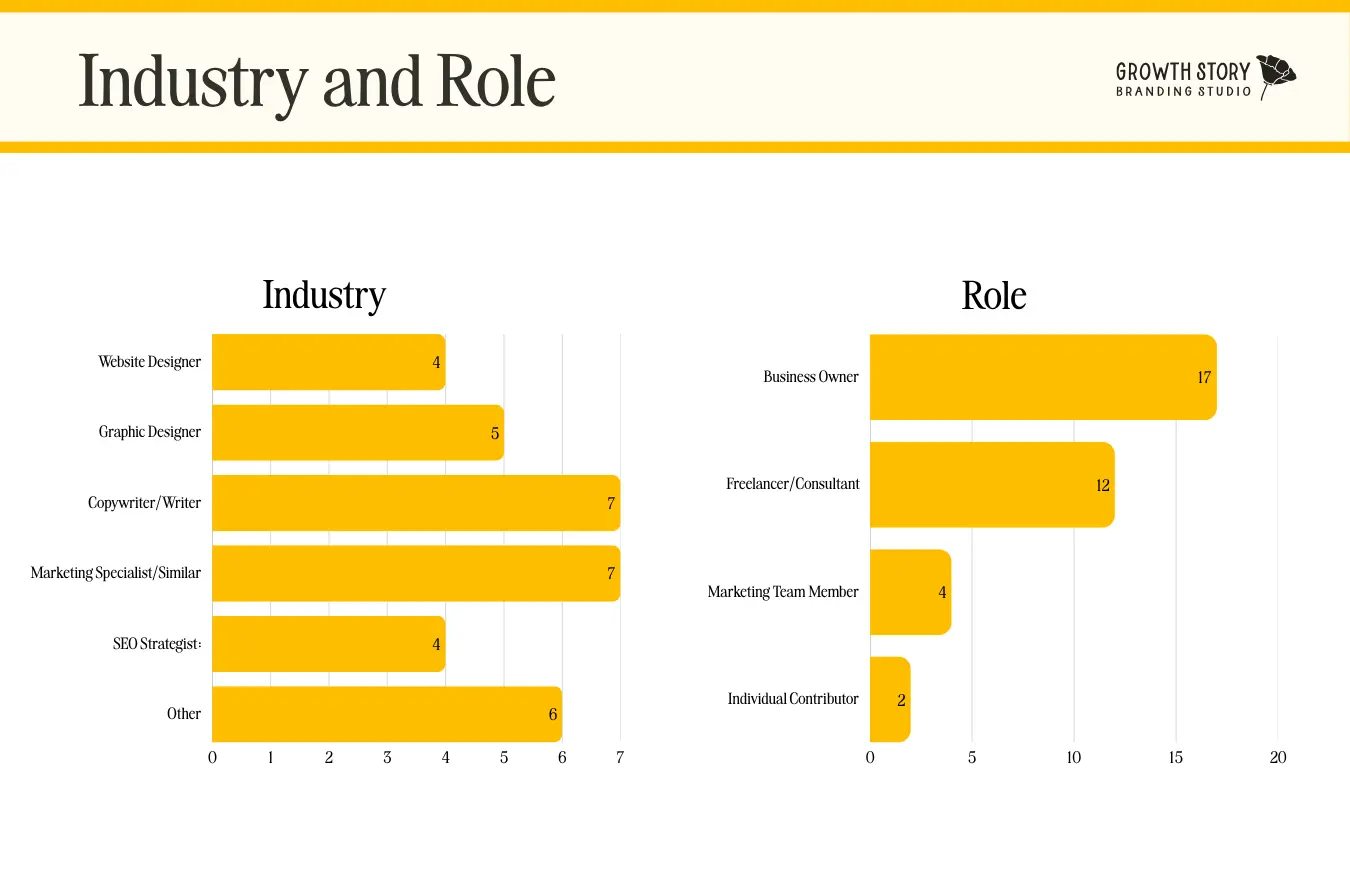
We collected responses from experts in industries all across the board, with the most common being website and graphic designers, copywriters, and marketing specialists or similar roles. Some outliers include an accountant, a legal professional, and a few in the tech space.
Role Type:
Most responses came from business owners, agency owners, or freelancers/consultants. We also have some insight from marketing team members and individual contributors.
Survey Results
Now, for the nitty gritty survey results. We asked a wide-range of questions, gathering information on AI use, personal feelings toward AI, specific findings, and relevant stories from encountering AI in the respondent’s industry.
Current AI Usage
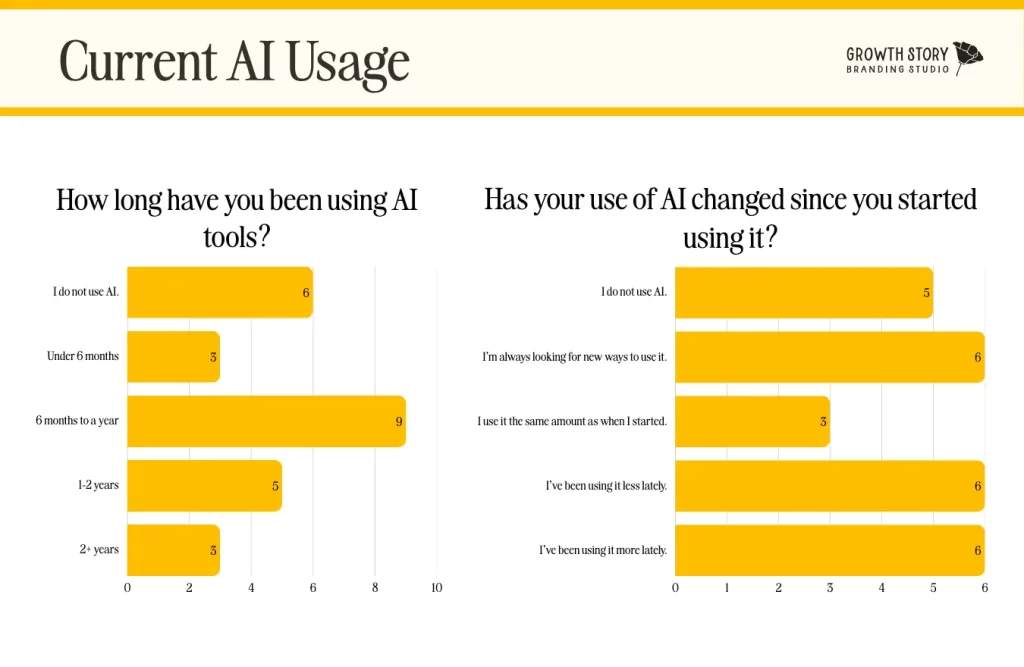
How long respondents have been using AI tools (ChatGPT, Claude, Gemini, etc.) is fairly split, with most people using it for 6 months to a year. You can see the timeline is all across the board, including a large chunk of people not using AI at all.
The ways participants use AI is also varied. Some are using it less lately, some more lately, and some people are always looking for new ways to utilize it.
General Feeling About AI
Personal feelings toward AI are fairly split. We even noticed individuals had torn feelings about it, thinking it could be useful but also could be problematic.
About ⅓ of respondents said they despised AI, 20% reported that they see it as a necessary evil, nearly 30% said they like using AI for some tasks, and just 8% said they love it.
Some respondents chose to express their specific thoughts and feelings, including:
- Conflicted about the morality of using it vs. not using it
- Concerns about the ethics
- Only using it because it’s required for jobs
- It’s useful and powerful, but it should be regulated
- Like it for certain tasks and despise it for others
- Hate generative AI, but think assistive AI can be useful
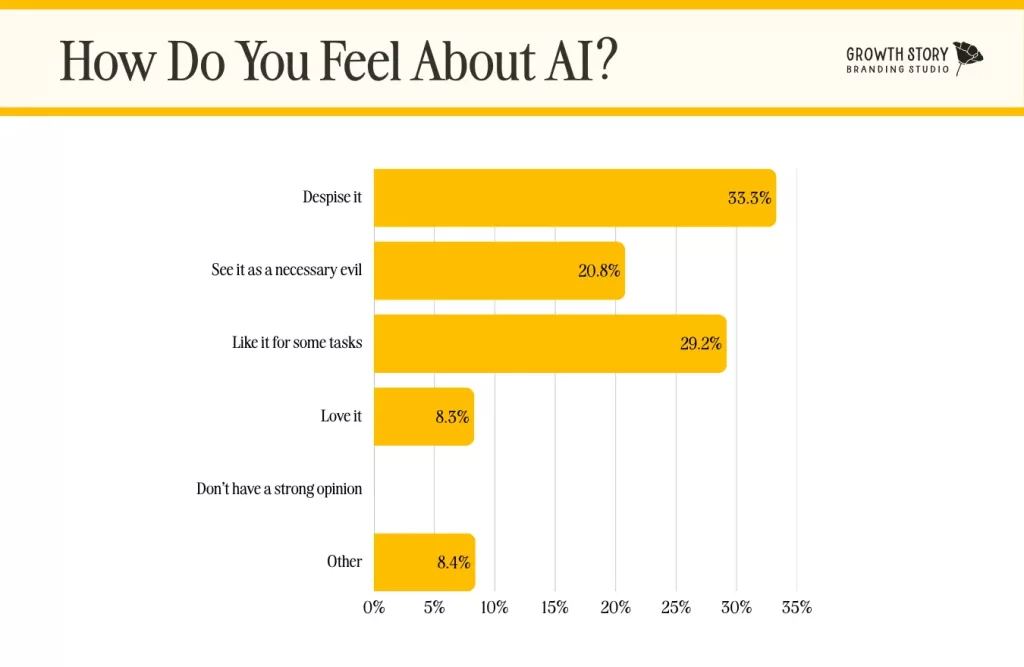
What stood out with these responses is that 0% of people said they don’t have a strong opinion about it. Love it, hate it, or torn about it, creative professionals definitely feel some type of way about AI.
Specific AI Findings
Next, we shared specific statements about AI and asked if the professionals completely disagree, mostly disagree, are neutral, mostly agree, completely agree, or if the statement isn’t relevant for them.
Some statements had mixed results; these are the ones that really stood out as they heavily leaned one way or another.
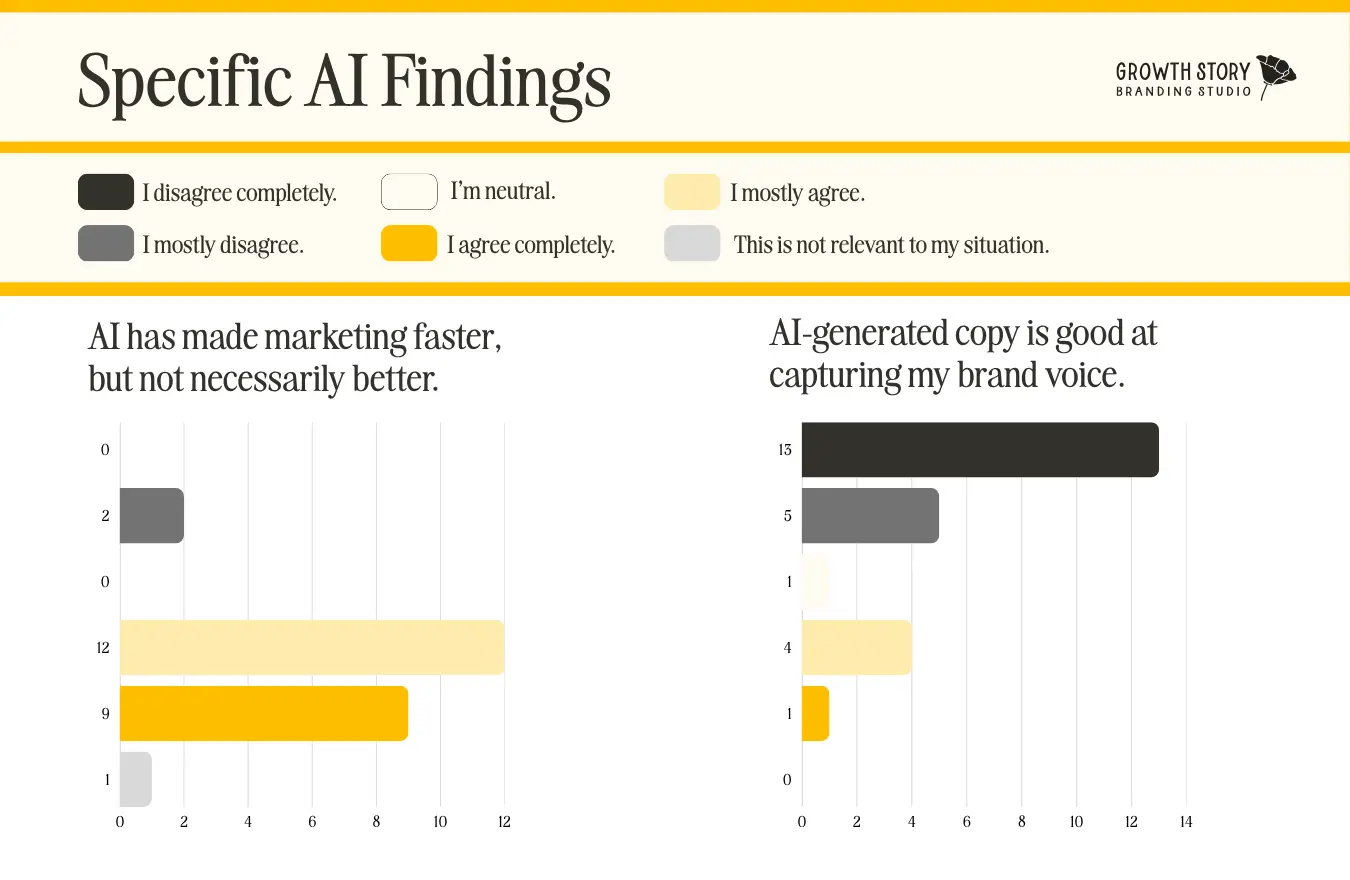
Statement 1: AI has made marketing faster, but not necessarily better.
A large majority of respondents reported mostly agreeing or agreeing completely that AI has sped up the output of marketing, but hasn’t necessarily improved the quality of what is produced.
Statement 2: AI-generated copy is good at capturing my brand voice.
More than half of the respondents strongly disagree that AI-generated copy is good at capturing their brand voice. This is very aligned with how we feel at Growth Story that human-written copy is best.
Even if you “train” the AI tool very well on your brand voice, it still is bound to sound less natural and more robotic than if it came from a human. And often in the time it takes you to train your AI tool or tweak its copy, you could have just written it yourself.
Statement 3: AI-generated copy rarely requires editing.
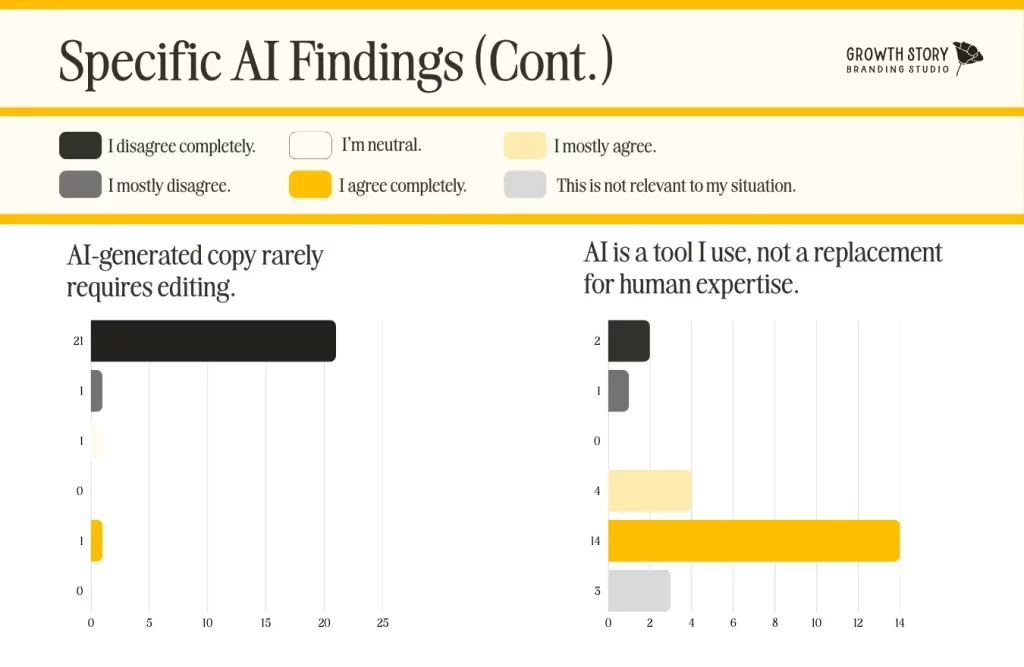
88% of respondents either mostly disagreed or disagreed completely that AI-generated copy rarely requires editing.
However, one respondent did agree completely with this statement. This is consistent with something we’ve seen in the marketing world lately: for the most part, people can identify AI content for the language patterns it frequently uses.
But some people are either blind to the AI patterns or they simply don’t care that the content isn’t perfect—often these people are impressed that it produced what it produced with the speed it produced it and are happy to copy & paste it exactly as-is.
Statement 4: AI is a tool I use, not a replacement for human expertise.
67% of respondents agreed mostly or completely that AI is a tool, not a replacement for human expertise.
This is consistent with a pattern we’ve been tracking among prospective clients and in conversation with other service providers.
There have always been people who will choose the cheapest option. And there have always been people who value expertise and are willing to invest in it.
We suspect that the people who have always chosen the cheapest option are the same people replacing human expertise with AI tools.
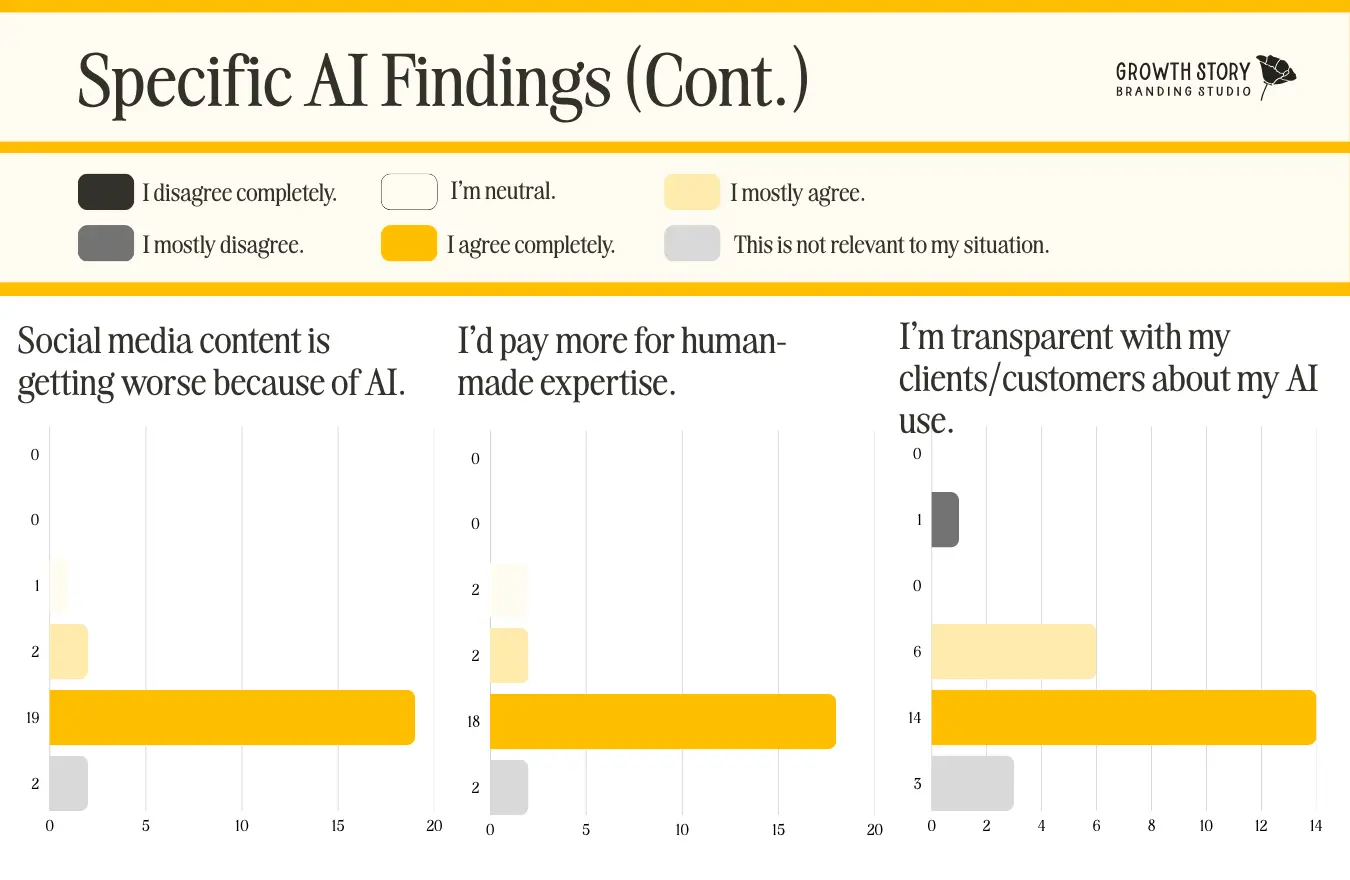
Statement 5: Social media content is getting worse because of AI.
We’ve all seen it: the dreaded Claude-created carousel. The content is robotic, the design hierarchy is nonexistent, and the design itself is overly complicated. Seriously, Claude loves a line accent. Once you start seeing it, you won’t be able to stop.
Statement 6: I’d pay more for human-made expertise.
See our commentary on statement 4 above.
Statement 7: I’m transparent with my clients/customers about my AI use.
We’re glad to see that most respondents are transparent with their clients or customers about their use of AI tools. We make our stance very clear with the AI policy linked in our footer.
A few things really stood out from these responses:
- AI may get the task done quickly, but it struggles to replace the quality of work that a human provides.
- People still value the expertise humans bring to the table.
- Social media, copy, and marketing in general is better received when it doesn’t come directly from AI.
Relevant AI Stories
In the next section of the survey, we asked for specific stories from experts, pertaining to AI. Here are a few responses for each situation.
Client Asking to Use or Avoid AI
Has a client/customer ever asked you to use (or avoid) AI? What happened?
“No, because it’s an upfront policy that I am vehement about and advertise as a competitive advantage.”
– Les, @tattedtrashreader
“Yes. I was writing emails myself first and they LOVED it, but because I was being charged for my time, they told me to use AI more because it was quicker and then I could just edit it. (This [was at] an e-commerce email marketing agency.) And that’s how we continued moving forward: using AI to write the copy, me going in and editing it to make it more human and more aligned with brand voice.”
– Anonymous
“I’ve been asked to sign an NDA that specifically called out not to use AI. Then, the client was very obvious about their own use of AI and told me to use it. We had to have an uncomfortable discussion about their say/do ratio and discrepancy between their NDA and later conflicting guidance.”
– Anonymous
Client Sending Something Created Using AI
How do you react when your clients/customers send you something obviously created using AI?
“As a copywriter this has shown up for me in copy editing a lot. I’ll receive pieces clearly written by AI and I politely point out the AI tells and what that means for trust. Then ask them if they want me to edit the piece to get rid of AI tells and the answer is always ‘yes please!’”
– Hazel Jones, Founder of Hazel Jones Copywriting
“I call them on it and steer them towards exploring the underlying doubt or indecision—without using AI.”
– Anonymous
“I rewrite it, because usually that is what they have hired me to do in the first place.”
– Jacquelyn Van Sant, Founder and CEO of Waymarks Web Studio
AI in Relation to Your Industry
What specific uses of AI in relation to your industry do you see that makes you cringe, angry, or some other emotion?
“The manipulation of photos and videos, creating fake experiences but presenting as true angers me and also makes me afraid.”
– Anonymous
“It’s the obtuse language, the complete erasure of author voice, and the fake urgency/importance inherent in AI-generated writing. Even though it looks good on the surface, it’s full of fluff and nonsense when you really look at it.”
– Abigail Keyes, Editor and Book Coach at Inkhorn Creative
“Other writers using AI to create content for their clients or to sell courses that teach AI writing. Writers using gimmicks to not get accused of using AI, even though they are not.”
– Blythe, Copywriter and Founder of Wordwoman Creative
What People Are Doing “Too Much” of With AI
What do you think people are doing too much of by using AI when it comes to your specific area of expertise and how is it detrimental to their goals/business?
“They are relying too much on it for their brand identity and marketing, and they end up fading into a background filled with more of the same. There is nothing new, exciting, or revolutionary in its output because it is sampling what already exists and pooping out the best average of what it sampled.”
– Chris, Illustrator and Graphic Designer at Chris Beck Art
“Outsourcing their brains. People are using it to draft whole blog posts which removes any specific expertise or personality and ultimately hurts post performance.”
– Shyanne, Owner and CEO of Shyanne Reynolds Copywriting
“Business posts, captions, flyers, Threads posts. It is entirely obvious and promotes an instant loss of trust.”
– Teddy Lennox, Director of Teddy Lennox Social
How AI Being Everywhere May Change Over Time
How do you see the ubiquity of AI-generated text, images, websites, etc. changing over the next few years?
“I think humans will realize how much value there is in working with other humans. And I believe AI will be looked at as a tool that can be used for part of the process, but not the entire project.”
– Brittany Herzberg, SEO Coach and Lead Gen Strategist at Copy By B.®
“I see a continued increase in the next few years, followed by a drastic decrease and changes when AI starts regulating itself.”
– Liz Krukosky, CEO and Founder of Cool Fire Inc.
“I think it will get worse before it gets better, but I haven’t lost all hope that things will come back around to human-made being the gold standard again”
– Anonymous
Growth Story’s AI Use Policy
As you can gather from this survey, how you use (or don’t use) AI in your business matters. We also believe transparency matters, with your clients and your team.
At Growth Story, we developed an AI Use Policy, so it’s clear how we choose to use and avoid AI within our agency and client projects. We highly recommend creating an AI Use Policy for your business as well.
Here’s an overview of our AI Use Policy:
“We use AI as a research and drafting tool, not a replacement for human-created strategy, voice, or creativity. Every client deliverable is shaped, refined, and approved by a human. AI helps us move faster and consider things we may not have thought of on our own, but we would never take something from AI and share it as a client deliverable.”
For the full Growth Story AI Use Policy, click here.
Internal Policies
The survey also included questions about AI Use Policies, both internally and client-facing. Here are those results.
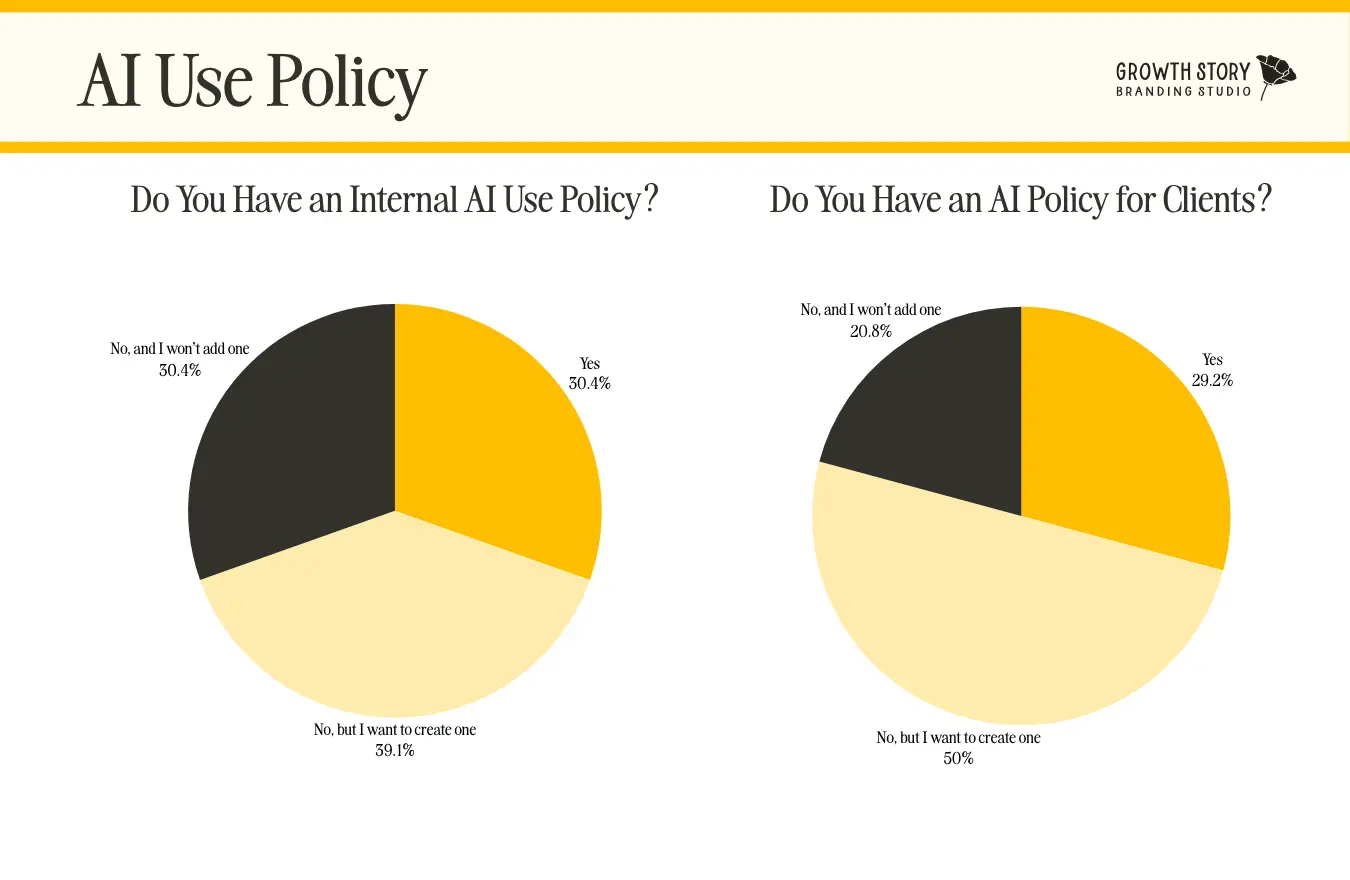
Do you have an INTERNAL-FACING AI use policy for your company?
Almost 70% of respondents either have or want to create an internal-facing AI use policy. This further ensures consistency with AI usage across your business or organization.
For those who have an internal-facing AI Use Policy, here are some inclusions:
- Protect client privacy
- No generative AI
- Everything must be human edited
- Only used for ideation
Client-Facing Policies
Do you have an AI policy or requirement for your clients/customers to follow?
We aren’t surprised that almost 80% of respondents have or want to create an AI policy for customers or clients. As a marketing agency, we aim to make our clients feel confident and supported—not ChatGPT. That means we want feedback and thoughts straight from their brains, instead of copied and pasted from AI.
For those who have an AI Use Policy for clients or customers, here are some things they cover:
- Clients using AI will be refused services
- Do not run our ideas through AI then follow its advice
- We bill extra to review AI responses
Final Thoughts from Creative Professionals
After reviewing all of the data, it’s evident that most creative professionals have strong feelings about AI. It’s important to do your own research, educate yourself, and then form your own opinions about your usage within your profession and life.
Just because it’s seemingly “everywhere”, doesn’t mean you lose the autonomy to choose whether or not and how you use it.
Here are a few closing thoughts, pulled from the survey responses:
- “I believe new roles and careers will evolve over the next decade to manage AI technology and outputs in ways we cannot imagine yet.” – Anonymous
- “People are not anti-AI because they don’t understand it or know how to apply it. I am anti-AI because I know TOO MUCH.” – Gail, Founder of Worksimple
- “We always hear “If you don’t use AI, you’ll fall behind”, but I firmly believe that you’ll fall behind by using too much AI or using it to replace the human elements of your business.” – Karley Parrish, Founder of Bud to Bloom Marketing
- “Everything is already extremely oversaturated. You’re doing a disservice to your business by creating things that blend in.” – Berlyn, Founder of Planted Marketing
- “Just because you can build something with AI doesn’t mean you should.” – Angela Noble, Co-Founder and Creative Director of Noble Intent
FAQs about AI in Creative Industries
AI is increasing creative outputs, making churning out content easier than ever before. However, that output is not necessarily better, as it often requires intense human-led revisions and blends in with what already exists. Human creativity is still valued and crucial for creating something that stands out.
An AI Use Policy clearly states how your company uses AI internally, and how you expect your clients and customers to use AI. For an AI Use Policy example, click here to explore ours.
AI is not replacing creative jobs, but it is shifting the creative landscape. AI still struggles to grasp the right brand voice, messaging, and creativity required to make the end result effectively stand out. Human expertise is still incredibly valued and needed, especially within the creative industries.
Creative professionals tend to have strong feelings toward AI, as it’s not regulated and many people aren’t informed about the dangers, ethics, and effectiveness of AI for creative work. They still value human expertise and believe that AI cannot provide a high-quality output the same way a professional does.