
Times are changing, especially when it comes to online marketing. If you’re confused about whether search engine optimization (SEO) is still important or if your firm needs to invest in AI optimization services, take a deep breath. This post answers the question, “Will AI replace SEO?”, and these insights are both reassuring and backed by research.
Introduction to AEO vs. AISO vs. SEO
Perhaps you’ve heard of the terms AEO and SEO, but you aren’t quite sure what the difference is. AEO stands for “Answer Engine Optimization”, and it refers to how your content is found via AI tools like Claude, ChatGPT, and Google AI Overviews. AISO stands for “AI Search Optimization”, and that is another term that represents optimizing your content to be found and recommended via those AI tools.
SEO stands for “Search Engine Optimization”, and this refers to how your content is written to be found on traditional search engines, such as Google or Bing. Two different terms, but as you’ll learn in this post, the strategies and structure behind them are quite similar.
Why SEO Still Matters
Even with AI being the “hot topic” right now, SEO remains fundamentally important. It provides the framework and context for AI tools to pull information from.
Long story short, SEO and AI search work hand-in-hand to get your website in front of prospects who search for you.
Here is a practical example of this. Recently, in the span of 24 hours, Growth Story received 2 consultation bookings. One booking came from AI search, and one came from traditional search. The Growth Story website (and all of our client websites) are built to be discovered—both by AI tools and by traditional search engines.
After all, the AI tools are pulling from the same content search engines pull from.
Here are some other reasons why SEO still matters.
AI is Not Always Accurate
While AI may improve over time, it’s not always accurate. Your prospects are on the verge of making a significant investment in your services, so they’re bound to do their due diligence in researching which firm to hire. They’ll likely still look you up on Google and dive into deeper research on your website before booking a consultation.
Users Use Multiple Channels for Research
Because AI isn’t always accurate (and everyone has their unique search preferences), prospects often use multiple channels for research.
Some may turn to ChatGPT, some Google, others social media, and some will utilize a combination of those channels. Optimizing your site for SEO ensures prospects can find you, no matter where they look.
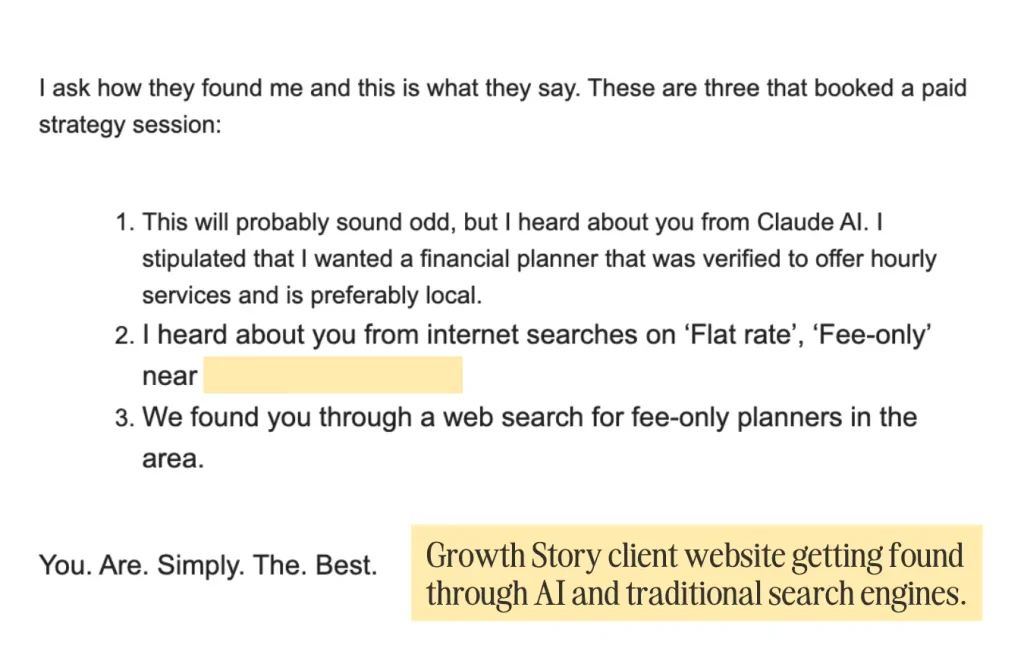
Here’s proof from one of our clients. She asked how paid strategy session clients found her, and received a combination of traditional search and AI search responses.
Her website was built on a foundation of SEO and humanized copywriting, so it could be found by all types of search engines.
SEO Provides Structure for AI Tools
AI may feel like magic to some, but the results it provides only show up thanks to optimization strategies. AI tools require a clear, readable structure using specific keywords, and that structure is SEO.
Foundational SEO tactics make it simple for an AI tool to scan your site, pull out your keywords, headings, and meta data, and have a clear understanding of who you serve, what you offer, and when to show your site in AI queries.
How to Appear in AI Search Results
One thing we won’t argue here is that it’s really nice to be discovered in AI search results. AI is essentially providing another referral channel to your website—just like social media, paid ads, Google, etc.
Of course you want to optimize your chances of being found on AI search if that’s where your prospects are looking for you.
You don’t need to invest in “AI optimization services” to be found via AI tools (and in fact, we highly recommend you don’t). If you have laid the SEO foundations, you already have the basic components of what AI needs to get your content in front of the right people.
Utilize the proper SEO structure and techniques and write your copy for real people…not bots. People search on AI tools the way they speak, so you want your copy to resonate with real humans.
The Growth Story Approach to SEO (and How It Supports AI Search)
At Growth Story, we don’t just design beautiful websites. We design websites that are built to be found, and that includes being found by AI search and traditional search engines. Here’s our approach to making that happen.
Start with Brand Strategy
All of our branding and website design projects begin with brand strategy. This is knowing exactly who you serve, what transformation you provide, and how you communicate that value.
Everything flows from this strategy—the visuals we design for your branding, the keywords we research for your site, and the copy we write from scratch. Being crystal clear on your messaging ensures that we’re optimizing for the right things (aka, you show up when your prospects search for what you offer).
That brand strategy combined with keyword research means we are using the words your ideal clients actually use when they are searching for the solution you provide—backed by data.
Traditional SEO Structure
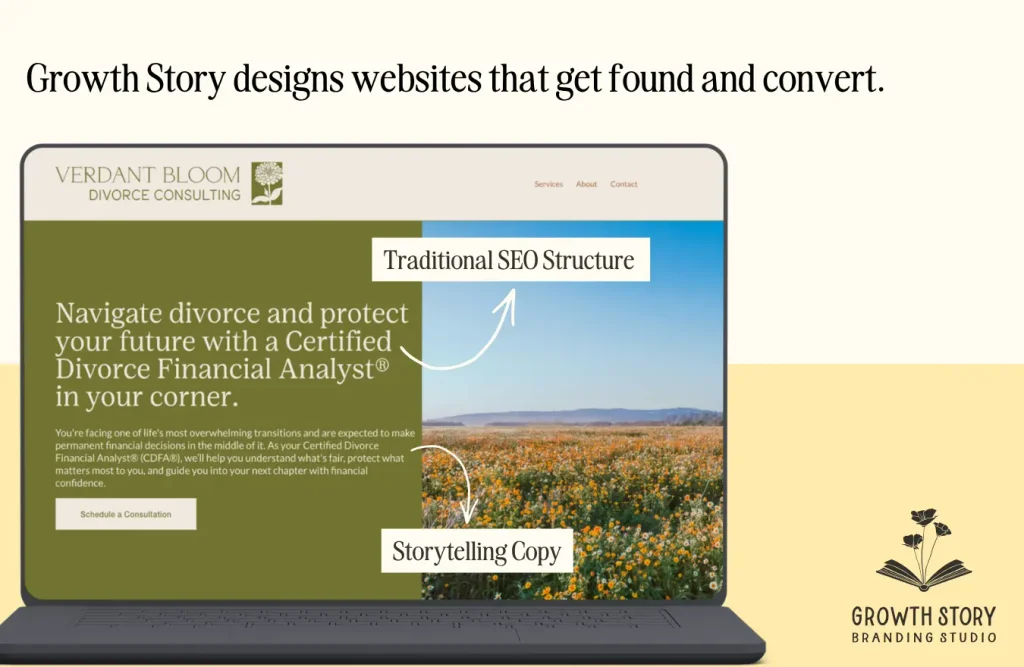
As previously discussed, having a traditional SEO structure on your website is crucial for being discovered by AI and search engines. This structure is baked into all of our client websites. We conduct extensive keyword research prior to writing your copy, so SEO is at the forefront (and not an afterthought).
Humanized Copywriting Rooted in Storytelling
Traditional SEO is crucial for AI tools, but it’s not the only piece of the puzzle. Humanized copywriting is how you connect with your prospects, build trust, and communicate that you are the right fit to help them solve their problems.
We also utilize storytelling as a way to make our clients’ complex services or offerings resonate with prospective clients.
Google is known to filter out overly-AI written content, so having humanized copy on your site eliminates that concern. And, when you think about how people write in an AI tool, they get very specific.
They don’t just use basic keywords like “Denver CPA”. They may type, “I’m looking for a CPA located in Denver that specializes in supporting women-owned small businesses making $250K revenue per year”.
The first part of their query is covered by SEO strategies, and the second part is covered by having brand clarity and strategic copy in place.
LLMS.txt is Added to All Client Websites
A new feature we’ve added to all our client websites is their LLMS.txt file. In simple terms, this file is written in a way AI models can easily read, and it includes a structured summary of their website, services, and links to the main pages that AI tools should pull from.
Current research shows it may or may not make a huge difference with the previous SEO and copy strategies in place, but it surely can’t hurt to add additional clarity for AI tools.
Get Your Website Found on Search Engines and AI Tools
Are you ready to have a beautifully designed website for your practice that clearly communicates your expertise and gets discovered by your prospects via search engines and AI tools?
Click here to schedule your free consultation with Allie, the founder of Growth Story.
FAQs about the Future of SEO With AI
Yes, traditional SEO is still crucial, even in the AI age. Optimizing your website and content for SEO provides the foundations for AI tools to pull from and ensures you’re showing up for the right queries.
AI-generated content is less likely to rank on search engines. In fact, Google prioritizes original, high-quality content, and AI content has a harder time being marked as original and valuable. Your best bet is to create humanized content that’s optimized for SEO.
Getting your content to show up in AI search results requires a combination of foundational SEO techniques, paired with original, humanized writing. If you focus on those two components and make your writing clear, you have a strong chance of showing up in AI search results.
The foundational SEO elements that AI tools benefit from are researching and optimizing with keywords, inputting relevant meta titles and descriptions, utilizing the proper heading structure, and adding alt text to images. All of our client websites are built from the ground up with SEO strategies in mind.