
As a busy professional practice owner, you don’t have the time to chase down prospects. That’s why it’s so important to have a website that clearly explains what you do, the transformation you provide for your clients, and how someone can work with you. A website conversion takes someone from a casual browser to a prospect in your pipeline. This post covers website conversion optimizations to add to your website to increase inquiries, so your website starts working for you—even when you’re busy with clients.
Common Website Conversion Goals
Before you add in conversion optimizations, outline the main action(s) you want someone to take when they land on your website. This goal can vary depending on your firm’s process and the capabilities of your website builder (e.g., Squarespace).
Psst: no idea where to start with this? This is just one piece of what we deliver in a Brand Strategy. Schedule a meeting with Allie to find out if that’s what you need.
Scheduling a Consultation
One of the most common website conversion goals is to schedule a consultation. Most prospective clients want to meet and talk to you over the phone before deciding you’re the right fit for them. This is often the first step they take before booking your services.
Filling Out a Form
Another common conversion goal is for prospects to fill out a form with contact information like their name, phone number, and email address, as well as relevant information on their situation and the service(s) that interest them. From there, you may reach out via a phone call or email with the next steps.
Signing Up for the Newsletter
If your business has an email newsletter, you likely have an opt-in form on your website where someone can join your email list. This is a powerful way to educate and nurture your prospects and keep in touch with them long term.
Why Your Site’s Conversion Rate Matters
A website’s conversion rate is the percentage of visitors who complete a desired action, such as booking a consultation, filling out a form, or signing up for a newsletter. Your conversion rate is important because it means visitors are interested in hearing more about your services and staying connected to your firm.
10 Website Conversion Optimizations to Increase Inquiries
Now that you have a clear understanding of what a conversion rate is and why it’s a crucial metric for your firm’s website, here are some website conversion optimizations to make that will increase your conversion rate and, in turn, increase your inquiries.
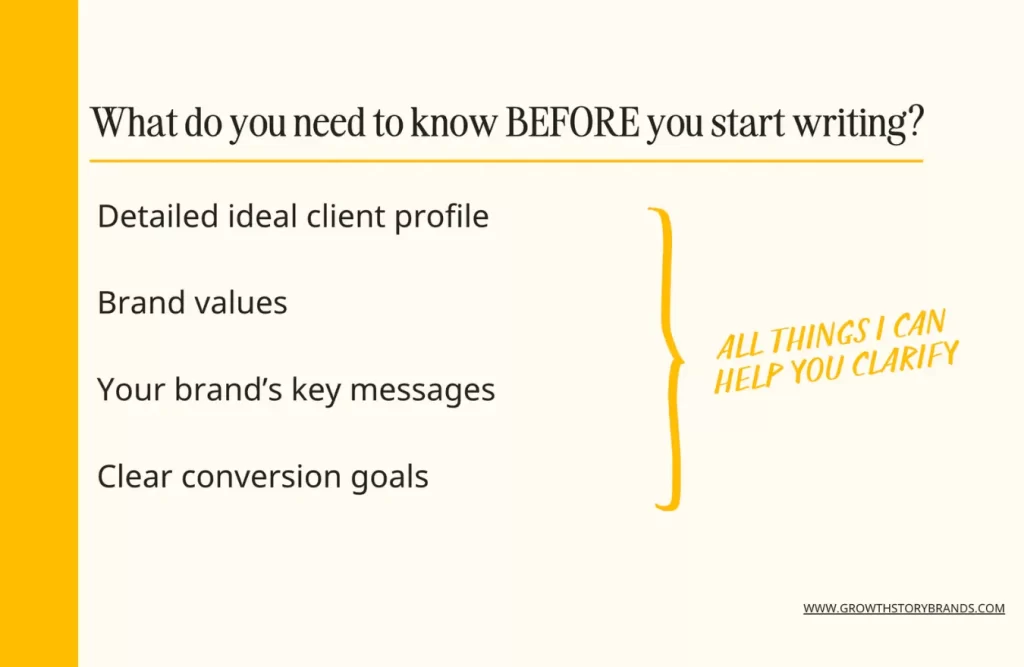
1. Clarify your brand messaging before you write your website copy.
Brand clarity is the strategic foundation of your business, and your website should effectively showcase it. When you clearly understand your brand messaging, you’re able to proudly articulate who your services are for and what sets your firm apart. That information is crucial for prospective clients when they’re deciding whether to hire you vs. a competitor.
2. State what you do in simple terms.
Your clients don’t need to know the ins and outs of what you do using complex jargon. Express what you do on your website using simple terms that anyone could understand, whether or not they work in your field.
3. Express how your work benefits prospective clients.
Before choosing to book a consultation or fill out a contact form, your prospects must understand how your work can help them. Put yourself in your clients’ shoes and write words that make them feel seen and heard. This builds trust with your prospects, and that trust will motivate them to take the next step with your firm.
4. Outline the process of working together.
If your prospective clients can’t envision what it’s like to work with you, they’ll likely move on. Inquiring with you may feel daunting or intimidating, especially if you deal with personal matters, so ease their minds by outlining step-by-step what your process looks like.

5. Include clear calls-to-action (CTAs) across your website.
CTAs encourage prospects to take that next step and convert. Don’t leave any page on your website as a dead-end; instead, include hyperlinks and buttons that clearly move them along to booking a consultation or filling out an inquiry form.
6. Answer your prospect’s questions before they have to ask.
Providing context and support for your prospects before they even reach out shows how intentional you are with your client experience. By answering commonly asked questions, you show that your clients are in good hands. On the other hand, a confused prospect will simply click away from your website.
7. Maximize your content above-the-fold.
The above-the-fold content on your website appears at the very top of the page, before a visitor scrolls down. This is the most important section, as it often determines whether someone continues to explore your site or closes the tab. Make sure this area clearly states what you do and how you help your clients.
8. Put your social media links in the footer, not header.
Following you on social media should not be the primary conversion goal for your website. When your social media links are in the header, they may distract prospects from your actual conversion goal. Add these links to the footer instead, so they’re accessible if someone wants to follow you, but they’re less likely to pull them away from your website.
9. Lead with your client’s story and their real-life situation.
Storytelling is a powerful tool to connect with your prospects and build trust. Truthfully, your prospects don’t care to read a long list of credentials. They want to know if you understand their unique, sometimes vulnerable, situation, and whether or not they can trust you to solve their problem. When it comes to the words on your website, lead with their real-life situation.
10. Include actual photos of you and your team to build connection and trust.
Prospects want to know who they’re hiring and trusting with their personal challenges. Stock photos, when used intentionally, may help balance out your website, but always include real photos of you and your team on your site. That way, prospective clients will connect with you even before speaking to you on the phone.

Ready to create a website that turns prospects into clients?
A website without clear conversion goals and an outlined conversion flow plan is just a pretty business card. The websites we create are built to showcase your expertise and work just as hard as you do by attracting prospects and turning them into clients.
We start with brand strategy as the foundation, so you clearly understand what you do, who you serve, and how to communicate your clients’ transformation. To learn more about creating a website that stands out, book a free consultation with Allie, the founder of Growth Story, here.
FAQs about Website Conversion Optimizations
Your website’s conversion rate is the percentage of visitors who take a desired action, such as booking a free consultation, filling out a form, opting into an email newsletter, etc. Conversion rate optimization means improving your website design and content to move someone from a casual browser to an engaged prospect.
Your website’s conversion goals vary depending on your process, but some of the most common ones for professional practices are scheduling a consultation, filling out an inquiry form, or signing up for an email newsletter.
There are many strategies to improve your website’s conversion rate. Prioritize having crystal clear messaging that defines what you do, how you help clients, and the transformation you facilitate for them. Answer prospective clients’ questions, such as the process of working with you and how to take the first step. Include clear calls-to-action, such as buttons and hyperlinks, to encourage prospects to take action.
Having a strong conversion rate means website visitors turn into prospect clients, then hopefully, booked clients. When your website is optimized for conversion, it means it’s working for you—even when you’re in meetings or on the phone with clients.